

How to Avoid Moving Scams: Protect Yourself Before You Hire a Mover
Moving scams are more common than most people realize. Every year, thousands of Americans fall victim to fraudulent moving companies that hold belongings hostage, charge double or triple the original quote, or simply disappear with a truck full of someone's life. The Federal Motor Carrier Safety Administration receives thousands of complaints annually, and those are just the ones that get reported.
If you're planning a move — especially a long-distance relocation — knowing how to spot a moving scam before it happens is the best way to protect yourself, your belongings, and your wallet. Here's a comprehensive guide to recognizing the warning signs and making sure you hire a legitimate, trustworthy mover.
How Moving Scams Typically Work
Most moving scams follow a predictable pattern. Understanding how they operate makes them much easier to avoid.
The most common scam starts with an unusually low estimate. You call a moving company, describe your household, and they quote you a price that's significantly lower than every other company you've contacted. It seems like a great deal, so you book it.
On moving day, the crew loads everything onto the truck. Once your belongings are on board, the price suddenly changes. The movers claim your shipment weighs more than expected, or they add fees for stairs, long carries, packing materials, or other services that were supposedly included in the original quote. Now you're faced with a choice: pay the inflated price or watch the truck drive away with everything you own.
This is called a hostage load, and it's one of the most devastating scams in the moving industry. Victims often end up paying two or three times their original estimate just to get their belongings back.
Another common scam involves companies that collect a large deposit and then never show up on moving day. By the time you realize what's happened, the phone number is disconnected, the website is gone, and your money is lost.
Some fraudulent movers operate under multiple business names to stay ahead of negative reviews and complaints. When one company name accumulates too many bad reviews, they simply shut it down and reopen under a new name with a clean slate.
Red Flags That Signal a Moving Scam
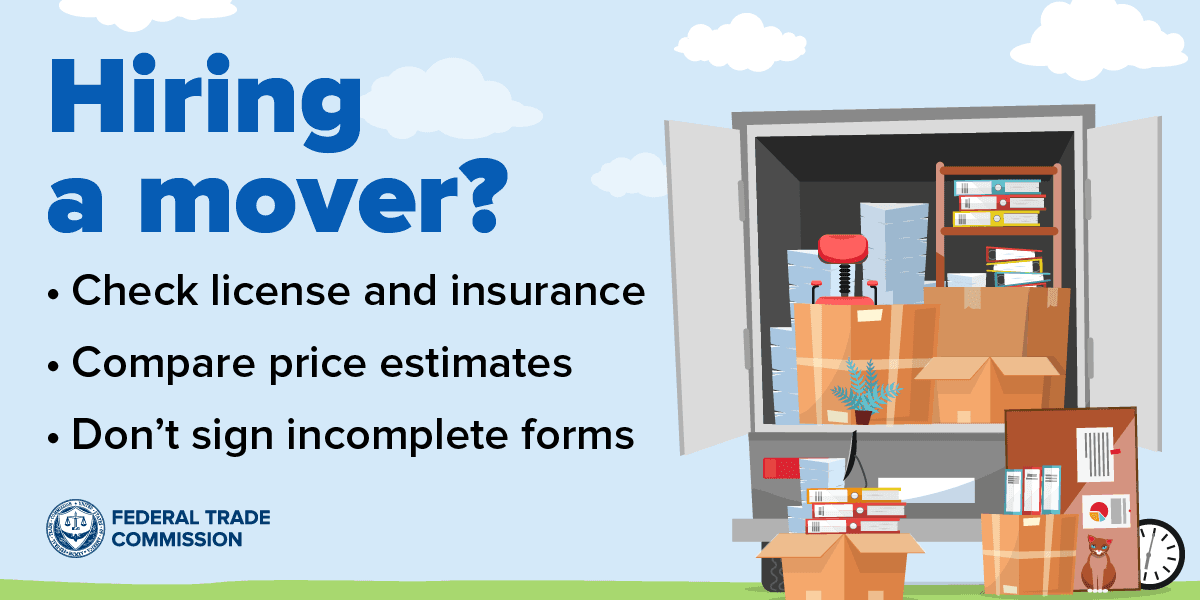
There are several warning signs that should immediately raise your suspicion when dealing with a moving company.
The estimate is dramatically lower than competitors. If you get quotes from five companies and one comes in at half the price of everyone else, that's not a bargain — it's a trap. Legitimate moving companies have real costs — labor, fuel, trucks, insurance — and they can't operate significantly below market rates without cutting corners or planning to inflate the price later.
They demand a large cash deposit upfront. Reputable movers may require a small booking deposit, typically payable by credit card. Any company that demands a large cash payment before the move is a major red flag. Cash payments are untraceable, which is exactly why scam operations prefer them.
They won't do an in-home or video survey. For any move of significant size, a legitimate mover will want to see your belongings before giving you a firm estimate. This can be done in person or via video call. If a company gives you a binding quote over the phone without asking detailed questions about your inventory, the estimate is almost certainly inaccurate — intentionally so.
The company has no physical address. Search for the company's address on Google Maps. Is it a real office or warehouse, or is it a P.O. box, a virtual office, or a residential address? Legitimate moving companies need space for trucks, equipment, and operations. A company with no physical presence is a company that can disappear overnight.
They answer the phone with a generic greeting. When you call, do they answer with the company name or just say "moving company"? Scam operations often run multiple fake businesses from the same phone line and use generic greetings to avoid confusion.
No USDOT number or a suspicious one. Every company that handles interstate moves must have a USDOT number from the Federal Motor Carrier Safety Administration. If a company can't provide one, they're operating illegally. Even if they give you a number, verify it on the FMCSA's website — some scammers use fake or stolen USDOT numbers.
They ask you to sign blank or incomplete documents. A legitimate moving contract should clearly detail every aspect of your move — the estimated cost, services included, pickup and delivery dates, liability coverage, and cancellation terms. Blank spaces or vague language in a contract are designed to be filled in later with charges you never agreed to.
The company has no online presence or only recent reviews. Check Google, Yelp, and the Better Business Bureau. If the company has no reviews, no website history, or only reviews from the past few months, they may be a rebranded scam operation. Use the Wayback Machine to check how long their website has existed.
How to Verify a Moving Company Is Legitimate
Before hiring any mover, take these steps to confirm they're the real deal.
Look up their USDOT number. Go to the FMCSA's SaferSys website and enter the company's USDOT number. This will show you their registration status, safety record, insurance coverage, and any complaints filed against them. For interstate movers, this is non-negotiable.
Check their state registration. For local moves within Florida, verify that the company is registered with the Florida Department of Agriculture and Consumer Services. Every state has its own registration requirements for movers, and legitimate companies comply with them.
Verify their insurance. Ask for proof of cargo insurance and liability coverage. A legitimate mover will have no problem providing this. If they dodge the question or provide documentation that looks questionable, walk away.
Read reviews across multiple platforms. Don't just check one site. Look at Google reviews, Yelp, the BBB, and moving-specific review sites. Cross-reference to get the full picture. Pay attention to patterns — if multiple reviewers describe the same problems, take it seriously.
Check the BBB for complaints. The Better Business Bureau tracks complaints and rates businesses based on their responsiveness. A company with a pattern of unresolved complaints is one to avoid, regardless of their star rating elsewhere.
Ask for references. Any reputable moving company should be willing to provide references from recent customers. If they refuse or make excuses, that tells you something.
How to Protect Yourself Before, During, and After Your Move
Even after verifying a company's legitimacy, there are additional steps you should take to protect yourself throughout the moving process.
Get everything in writing. Your moving estimate, the services included, the pickup and delivery dates, the liability terms, and the total cost should all be documented in a written contract. Verbal promises mean nothing when there's a dispute.
Choose a binding estimate. A binding estimate locks in your price based on the inventory of items being moved. As long as the actual inventory matches what was documented, the price can't change. Non-binding estimates can increase on moving day, which is how many scams operate.
Pay with a credit card. Credit card payments give you the ability to dispute charges if something goes wrong. Cash and wire transfers offer no protection. If a company insists on cash only, that's a red flag.
Take photos and video of your belongings before the move. Document the condition of your furniture, electronics, and valuables before the movers touch anything. If something is damaged during the move, this documentation is essential for filing a claim.
Create a detailed inventory list. Write down every item being loaded onto the truck. Check items off as they're delivered. If something is missing, you'll have documentation to support your claim.
Be present on moving day. Don't leave the movers unsupervised. Watch the loading process, ask questions, and make sure nothing seems off. If the crew starts talking about additional charges that weren't in your contract, address it immediately.
Read the bill of lading carefully before signing. The bill of lading is the official contract between you and the mover. It should match your estimate and include all the terms you agreed to. Never sign it without reading every line.
How MoveSafe Relocation Protects You from Moving Scams
At MoveSafe Relocation, we understand the concerns people have about the moving industry — because we've seen what bad actors do to customers, and we've built our entire business around being the opposite of that.
Here's how MoveSafe Relocation operates differently from the scam companies described above.
We're fully licensed and registered. MoveSafe Relocation is registered with the Federal Motor Carrier Safety Administration with a valid USDOT and MC number. You can verify our credentials anytime on the FMCSA's website. We don't hide behind fake numbers or shell companies — our licensing information is publicly available because we have nothing to hide.
We're transparent about being a broker. One of the biggest complaints in the moving industry is companies that pretend to be carriers when they're actually brokers. We don't do that. From the very first conversation, we're upfront about our role. We coordinate your move through a vetted network of licensed, insured carriers — and we explain exactly how that process works before you sign anything.
We provide detailed, binding estimates. Our quoting process is thorough because we know that inaccurate estimates are the number one source of complaints in this industry. We ask detailed questions about your inventory, your timeline, and any special items so the estimate we provide is as close to the final cost as possible. When we give you a binding estimate, that price is locked in — no surprises on moving day.
We vet every carrier in our network. Not every carrier meets our standards. Before a moving company joins our network, we verify their USDOT number, check their safety record, confirm their insurance coverage, and review their customer feedback history. We don't just hand your move to the cheapest available truck — we match you with a carrier that has the experience, equipment, and track record to handle your specific move properly.
We stay involved throughout your entire move. Some brokers disappear after booking. That's not how we operate. Our team stays in contact with you from the moment you book until your belongings are delivered. If there's a delay, a scheduling change, or any issue with the carrier, we're available to step in and help resolve it.
We have a real office and a real team. MoveSafe Relocation is based in South Florida with a physical office and a dedicated team of moving coordinators. We're not a one-person operation running out of a spare bedroom with a burner phone. When you call us, a real person answers and identifies themselves by name.
We never ask for large cash deposits. Our booking process is straightforward and reasonable. We accept credit card payments, which gives you consumer protection and a paper trail. We would never pressure you into a large upfront cash payment — and you should be wary of any company that does.
We respond to every review. Whether the feedback is positive or negative, we respond publicly. We believe that how a company handles criticism says more about their integrity than any five-star review ever could. If a customer has a less-than-perfect experience, we want to know about it so we can make it right.
We built MoveSafe Relocation to be the kind of moving broker we'd want to hire ourselves — transparent, responsive, and accountable. We know trust is earned, not given, and we work every day to earn it from every customer.
What to Do If You've Been Scammed
If you suspect you've fallen victim to a moving scam, take action immediately.
File a complaint with the FMCSA. They investigate complaints against interstate movers and can take enforcement action against companies that violate federal regulations. You can file online through their National Consumer Complaint Database.
Contact your state's attorney general office. They handle consumer protection complaints and can investigate fraudulent businesses operating within the state.
File a complaint with the Better Business Bureau. While the BBB doesn't have enforcement power, their complaints are public and can warn other consumers. Companies also face pressure to resolve BBB complaints to maintain their rating.
Dispute the charges with your credit card company. If you paid with a credit card and the mover didn't deliver on their contract, you may be able to get a chargeback. Provide all documentation — your contract, the estimate, photos, and a description of what happened.
Report the company to local law enforcement if they've committed theft or fraud. Holding belongings hostage for ransom is illegal, and police reports create a paper trail that can support civil action.
Consult an attorney if the financial loss is significant. Many consumer protection attorneys offer free consultations and may take moving fraud cases on contingency.
Key Takeaways
The most common moving scam is a lowball estimate that skyrockets on moving day
Always verify a mover's USDOT number on the FMCSA website before hiring
Never pay large cash deposits — use credit cards for consumer protection
Get binding estimates and detailed written contracts with no blank spaces
MoveSafe Relocation is fully licensed, transparent, and vets every carrier in its network
If scammed, file complaints with the FMCSA, state attorney general, and your credit card company
Moving Scam Red Flags vs Legitimate Mover Signs
Red Flag (Potential Scam) | Green Flag (Legitimate Mover) |
Estimate far below all competitors | Competitive, realistic pricing |
Large cash deposit demanded upfront | Small credit card deposit |
No USDOT number or can't provide one | Valid, verifiable USDOT and MC numbers |
No physical address or office | Real office with trucks and equipment |
Generic phone greeting | Answers with company name, professional staff |
Refuses in-home or video survey | Offers detailed inventory walkthrough |
Blank or incomplete contract | Detailed written estimate with all terms |
No online reviews or only recent ones | Consistent review history across platforms |
Pressures you to sign immediately | Gives you time to compare and decide |
Won't explain their pricing breakdown | Transparent about every charge |
Where to Verify a Moving Company
Resource | What It Checks | Website |
FMCSA SaferSys | USDOT status, safety record, insurance, complaints | |
FL Dept of Agriculture | State mover registration (local FL moves) | |
Better Business Bureau | Complaint history, company rating | |
Google Reviews | Customer feedback patterns | |
Yelp | Customer reviews and photos |
Frequently Asked Questions
What is a hostage load in moving?
A hostage load occurs when a fraudulent mover loads your belongings onto the truck and then demands a price far higher than the original estimate. Your belongings are essentially held hostage until you pay the inflated amount. This is illegal and should be reported to the FMCSA and local law enforcement.
How can I verify if a moving company is legitimate?
Look up their USDOT number on the FMCSA's SaferSys website. Check for state registration, verify insurance, read reviews across multiple platforms, and confirm they have a physical business address. If they can't provide these credentials, don't hire them.
Is MoveSafe Relocation a scam?
No. MoveSafe Relocation is a fully licensed and registered moving broker with valid USDOT and MC numbers that can be verified on the FMCSA's website. We operate with complete transparency about our role as a broker, provide binding estimates, vet every carrier in our network, and maintain a physical office in South Florida.
Should I pay my movers in cash?
No. Always pay by credit card. Credit card payments give you the ability to dispute charges if the mover doesn't deliver on their contract. Cash and wire transfers offer no consumer protection and are preferred by scam operations for exactly that reason.
What should I do if a mover won't release my belongings?
Contact local law enforcement immediately, as holding belongings for ransom is illegal. File a complaint with the FMCSA, your state attorney general, and the Better Business Bureau. If you paid by credit card, initiate a chargeback with your credit card company.
Conclusion
Moving scams are preventable. The red flags are well-documented, the verification tools are free and publicly available, and the steps to protect yourself are straightforward. Always verify USDOT numbers, get binding estimates in writing, pay with a credit card, and trust your instincts when something feels off. Companies like MoveSafe Relocation exist because we believe the moving industry can and should operate with transparency and integrity. Do your homework, ask the hard questions, and choose a mover that earns your trust before they earn your business.
Choosing a Mover You Can Trust
The moving industry has its share of bad actors, but there are plenty of honest, professional movers and moving brokers who do excellent work every day. The key is doing your homework before you hand over your belongings.
Verify credentials. Get multiple quotes. Read reviews with a critical eye. Get everything in writing. Pay with a credit card. And trust your instincts — if something feels off about a company, it probably is.
Your belongings represent your life — your memories, your investments, your comfort. They deserve to be in the hands of someone who takes that responsibility seriously.
If you're looking for a moving partner you can trust for your next relocation, reach out to our team at MoveSafe Relocation. We'll walk you through the process with complete transparency, provide a detailed estimate, and make sure you know exactly what to expect every step of the way. No scams. No surprises. Just a professional, honest moving experience.
Ready to Plan Your Move?
Get a free, no-obligation quote from our team of moving experts. We handle residential, commercial, and long-distance relocations across all 50 states.


