

The Complete Long-Distance Moving Checklist: Everything You Need to Do Before, During, and After Your Move
A long-distance move is one of the most complex things you'll ever coordinate. Unlike a local move where you can make multiple trips or run back for forgotten items, a long-distance relocation requires everything to go right the first time. Your belongings are loaded onto a truck, driven hundreds or thousands of miles, and delivered to a new home in a new city — sometimes in a new state where you don't know anyone yet.
The difference between a smooth long-distance move and a disaster usually comes down to preparation. The more organized you are in the weeks and months leading up to your move, the less stressful the actual transition will be.
Here's a complete long-distance moving checklist that covers everything from eight weeks out to your first week in your new home.
Eight Weeks Before Your Move
The planning phase starts now. Eight weeks might feel like plenty of time, but for a long-distance move, it goes fast.
Research moving companies and get quotes. Start by requesting estimates from at least three to five moving companies or brokers. For long-distance moves, pricing is typically based on the weight of your shipment and the total distance. Get binding estimates whenever possible so the price is locked in. Compare not just the bottom line, but what's included — packing services, insurance, storage options, and delivery windows.
Verify credentials. Check every company's USDOT number through the FMCSA's website. For moves within Florida, confirm state registration. Read reviews on Google, the Better Business Bureau, and Yelp. Don't skip this step — it's your best defense against moving scams.
Create a moving binder or digital folder. Organize all your moving documents in one place — estimates, contracts, inventory lists, important personal documents, and contact information for everyone involved in your move. Having everything centralized saves time and reduces the chance of losing something critical.
Start decluttering. Long-distance moves are priced by weight and volume. Every item you eliminate saves money. Go room by room and sort everything into keep, sell, donate, and throw away categories. Be ruthless — if you haven't used it in a year, you probably don't need to pay to move it across the country.
Notify your employer. If your move is job-related, coordinate the timeline with your employer. If you're transferring within a company, ask about relocation assistance or reimbursement — many companies cover part or all of the moving costs for employee relocations.
Six Weeks Before Your Move
Book your movers. Don't wait until the last minute, especially if you're moving during peak season from May through September. The best carriers fill up fast, and last-minute bookings often come with premium pricing. Lock in your date and get your contract signed.
Start packing non-essential items. You don't need your holiday decorations, extra linens, out-of-season clothing, or that box of books you haven't touched in two years. Pack these items now so you're not scrambling in the final week.
Notify important parties of your address change. Start updating your address with banks, credit card companies, insurance providers, the IRS, subscription services, and anyone else who sends you mail. File a change of address with USPS to forward your mail to your new address.
Research your new area. If you haven't already, start familiarizing yourself with your new city. Find doctors, dentists, veterinarians, schools, and grocery stores near your new home. Join local community groups on Facebook or Nextdoor to start connecting with your new neighbors.
Transfer or close local accounts. Gym memberships, dry cleaners, house cleaning services, lawn care — anything tied to your current location needs to be cancelled or transferred.
Four Weeks Before Your Move
Schedule utility disconnections and connections. Contact your current utility providers to schedule disconnection for the day after your move-out date. Arrange for utilities at your new home — electricity, gas, water, internet, and trash service — to be connected before you arrive.
Pack room by room. Continue packing systematically. Label every box on at least two sides with its contents and the room it belongs in. Use a numbering system if you want to track inventory — number each box and keep a master list of what's inside each one.
Arrange travel logistics. If you're driving to your new home, plan your route, book hotels if it's a multi-day drive, and schedule any vehicle maintenance. If you're flying, book your flights and arrange ground transportation at your destination.
Handle vehicle registration and driver's license requirements. Research your new state's requirements for vehicle registration and driver's license transfer. Most states require you to register within 30 days of establishing residency. In Florida, you'll need to get a Florida driver's license and register your vehicle within 30 days.
Refill prescriptions. Make sure you have enough medication to last through the transition period. Transfer your prescriptions to a pharmacy near your new home or ask your doctor for extra refills.
Arrange care for pets and kids on moving day. Moving day is chaotic. Having small children and pets underfoot while movers are loading a truck is stressful for everyone. Arrange for someone to watch them during the loading process.
Two Weeks Before Your Move
Confirm everything with your movers. Call your moving company or broker to reconfirm your pickup date, delivery window, and all the details of your contract. Make sure nothing has changed and that everyone is on the same page.
Pack an essentials bag. This is the most important box you'll pack. Include everything you'll need for the first few days in your new home before your shipment arrives — toiletries, medications, a change of clothes for each family member, phone chargers, important documents, basic kitchen supplies, paper towels, trash bags, and tools for reassembling furniture.
Clean and prepare your current home. If you're renting, start deep cleaning to get your security deposit back. If you're selling, make sure the home is ready for the final walkthrough.
Return borrowed items and collect your things. Return library books, borrowed tools, and anything else that belongs to someone else. Pick up dry cleaning, packages, and anything you've left at friends' or neighbors' homes.
Take photos of electronics setups. Before you disconnect your TV, computer, router, and entertainment system, take photos of the cable connections. This makes reassembly at your new home much faster.
One Week Before Your Move
Finish packing. Everything except the items you're using daily should be packed. Focus on the kitchen, bathrooms, and bedroom last since you'll need those until the final day.
Defrost your freezer. If you're bringing your refrigerator, it needs to be defrosted and dried at least 24 hours before the movers arrive. Clean it out and either use up or dispose of perishable food.
Disassemble large furniture. Beds, dining tables, bookshelves, and other large furniture should be disassembled to save the movers time and to protect the pieces during transit. Bag and label all hardware and tape it to the corresponding furniture.
Prepare your home for the movers. Clear pathways, protect floors if needed, and make sure there's parking space for the moving truck. If you live in a building with elevator restrictions or loading dock requirements, coordinate with management.
Withdraw cash for tips. Moving day tips are customary. Have cash on hand so you're not scrambling to find an ATM on a hectic day. A standard tip is $50 to $100 per mover for a long-distance move.
Moving Day
Be present and available. You or someone you trust should be at the home throughout the loading process. Walk through the house with the crew leader before they start, point out any fragile items or special instructions, and be available to answer questions.
Do a final walkthrough. Before the truck leaves, check every room, closet, cabinet, and storage area. Look in the attic, garage, and any outdoor storage. It's easy to forget items in places you don't check regularly.
Review and sign the bill of lading. This is the official document that governs your move. Make sure it matches your estimate and contract. Note the condition of your belongings on the inventory sheet — if something is already damaged, document it before the movers take it.
Get contact information and delivery details. Confirm the driver's contact number, the expected delivery window, and the process for reaching your moving company if you have questions during transit.
First Week in Your New Home
Inspect your delivery. When the truck arrives, check every item against your inventory list as it's unloaded. Note any damage immediately on the delivery receipt before signing. Take photos of any damaged items for your records.
Set up essential rooms first. Get the beds made, the bathroom functional, and the kitchen operational before worrying about unpacking everything else. Having a comfortable place to sleep and a working kitchen makes the first few nights much more manageable.
Update your address with remaining accounts. If there are any accounts you didn't update before the move, do it now. Update your voter registration, vehicle registration, and driver's license as required by your new state.
Explore your new neighborhood. Take walks around your neighborhood. Locate the nearest grocery store, gas station, pharmacy, and hospital. Introduce yourself to neighbors. The sooner you start building familiarity with your surroundings, the sooner your new house will feel like home.
Give yourself grace. Long-distance moves are exhausting — physically, mentally, and emotionally. Don't expect to have everything unpacked and organized in the first week. Take breaks, explore your new city, and allow the adjustment to happen at its own pace.
Key Takeaways
Start planning a long-distance move at least eight weeks in advance
Get binding estimates from three to five movers and verify all USDOT credentials
Declutter aggressively before packing — every item you eliminate saves money
Pack an essentials bag with 48 hours of necessities and keep it with you
Update your address, transfer documents, and set up utilities before moving day
Inspect every item on delivery and document any damage before signing
Long-Distance Moving Timeline
Timeframe | Key Tasks |
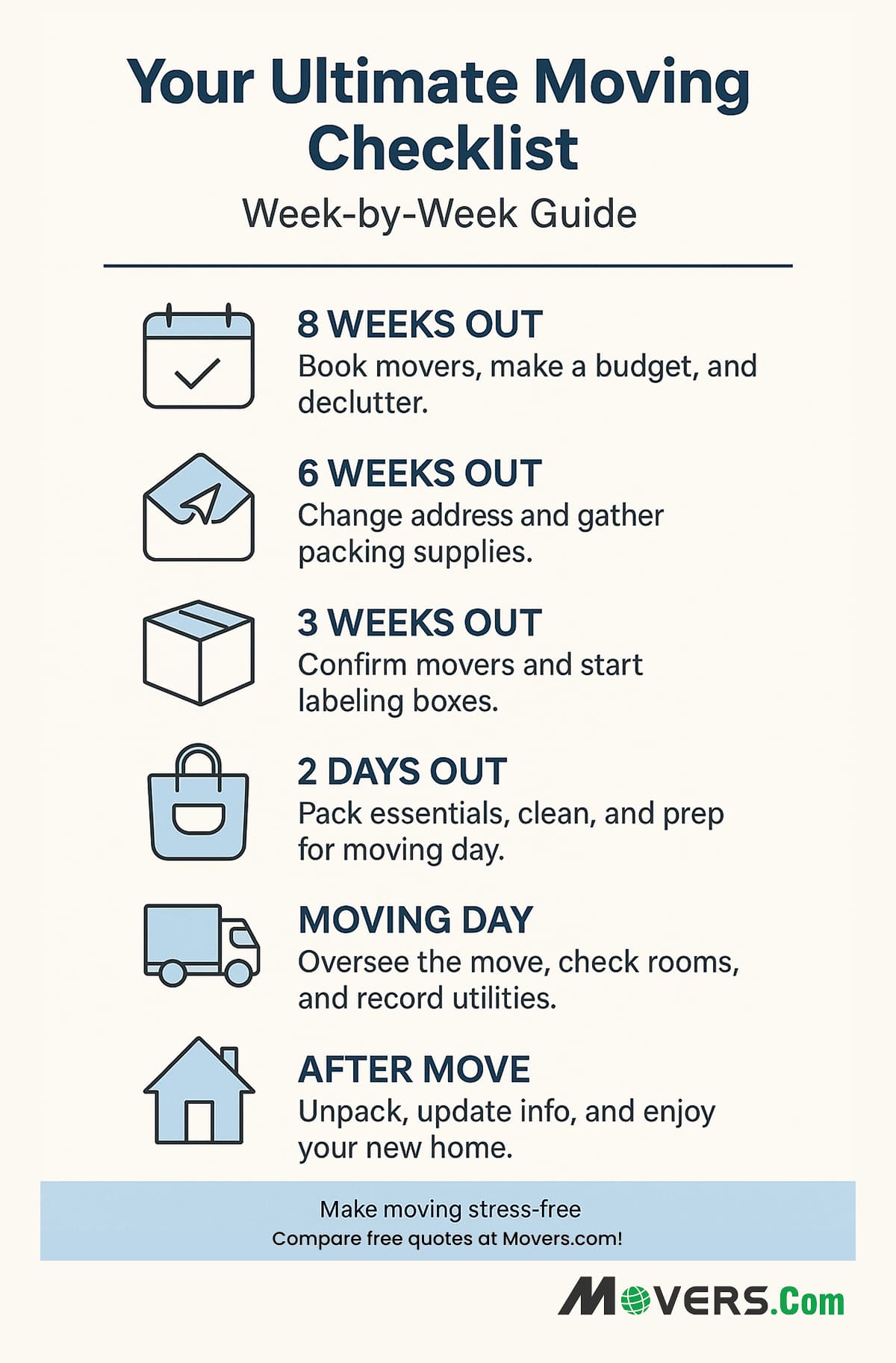
8 weeks before | Research movers, get quotes, start decluttering, create moving binder |
6 weeks before | Book movers, start packing non-essentials, update address with banks/USPS |
4 weeks before | Schedule utility disconnections and connections, pack room by room |
2 weeks before | Confirm with movers, pack essentials bag, clean current home |
1 week before | Finish packing, defrost freezer, disassemble furniture, prep home for movers |
Moving day | Be present, final walkthrough, review bill of lading, get driver contact info |
First week | Inspect delivery, set up essential rooms, update remaining accounts, explore |
Moving Cost Factors for Long-Distance Moves
Factor | Impact on Cost | How to Save |
Shipment weight | Higher weight = higher cost | Declutter before packing |
Distance | More miles = more expensive | Can't change, but compare quotes |
Time of year | Peak season (May–Sept) costs more | Move in fall or winter |
Packing services | Adds $200–$800+ | Pack yourself if possible |
Specialty items | Piano, safes, art add extra charges | Sell or donate if not needed |
Storage | $50–$300/month if timelines don't align | Align move-in/move-out dates |
Insurance | Full replacement value costs more | Worth it for high-value moves |
Frequently Asked Questions
How far in advance should I book a long-distance move?
At least six to eight weeks in advance. During peak season from May through September, booking even earlier is recommended since the best carriers fill up fast.
How much does a long-distance move cost?
Costs vary based on distance, shipment weight, and services. A one-bedroom long-distance move typically costs $1,500 to $3,000, while a four-bedroom home can run $6,000 to $10,000 or more.
What should I pack in my essentials bag?
Include toiletries, medications, phone chargers, a change of clothes for each family member, important documents, basic cleaning supplies, paper towels, trash bags, paper plates, utensils, and tools for reassembling beds.
Do I need to update my driver's license when I move to a new state?
Yes. Most states require you to get a new driver's license and register your vehicle within 30 days of establishing residency. In Florida, this is a legal requirement.
What if my belongings arrive damaged?
Note all damage on the delivery receipt before signing and take photos immediately. File a claim with the moving company as soon as possible. Having a pre-move inventory with photos strengthens your claim.
Conclusion
A long-distance move is a major project, but with the right timeline and checklist, it's completely manageable. The key is starting early, staying organized, and not leaving critical tasks for the last minute. Book your movers well in advance, declutter before you pack, keep your essentials close, and document everything on delivery day. Follow this checklist and you'll arrive at your new home with less stress and more confidence.
Making Your Long-Distance Move Easier
A long-distance move will always involve some level of stress, but proper planning dramatically reduces the chaos. Follow this checklist, stay organized, and don't leave things to the last minute.
If you're planning a long-distance move to or from South Florida, we can help coordinate every detail. From matching you with the right carrier to keeping you informed throughout the process, our goal is to make your relocation as smooth and stress-free as possible. Get a free quote today and let's start planning your move.
Ready to Plan Your Move?
Get a free, no-obligation quote from our team of moving experts. We handle residential, commercial, and long-distance relocations across all 50 states.